Something unusual is happening in America’s housing market. People just aren’t moving anymore.
According to new research from the Federal Reserve Bank of Boston, household mobility has plunged since 2020. And that too with older homeowners leading the ‘Great Stay.’
Moreover, between 2019 and 2023, moves among people aged 65–79 fell by 11%. While younger households dropped 8%. It’s not just about comfort. It’s the math.
Mortgage rates have doubled, listings are down 30%, and millions are locked into low-rate loans. The result? Homes aren’t changing hands, supply is drying up, and the American dream of trading up is quietly being replaced by staying put. Let’s discuss it in detail:
1. The Inventory Lock-In
The ‘Great Stay’ shows up most clearly in inventory. According to the data available on Reventure App, active listings across the U.S. hit 1.1 million in 2025, almost double the pandemic low of 578,000 in 2021, but still well below pre-2020 levels near 1.3 million. The brief rebound looks healthy. However, it hides a deeper truth that homeowners simply aren’t moving.

Active listings jumped to 1.1 million in 2025, nearly double the pandemic low. Yet the market still feels frozen. Access the above graph here. [Link]
Millions refinanced into 3% mortgages and are now stuck guarding their golden loans. Listing your home today means giving up that deal for a 7% rate, and most Americans won’t. As the Boston Fed noted, older homeowners are driving this inertia. Their moves dropped 11% between 2019 and 2023.
This is why inventory feels frozen even with a small uptick. There’s movement at the edges like forced sales, relocations, divorces. But not enough turnover to feed normal demand. The U.S. housing market has become a closed loop, where buyers and sellers are the same people, both waiting for the other to blink.
2. The Income Plateau
Next comes the affordability story. According to the data available on Reventure App, the median U.S. household income climbed steadily to $83,200 in 2025, up from $46,200 in 2005. That’s nearly an 80% jump in twenty years. It is impressive until you factor in housing costs. Home prices have risen two to three times faster. And mortgage payments have doubled in just three years.
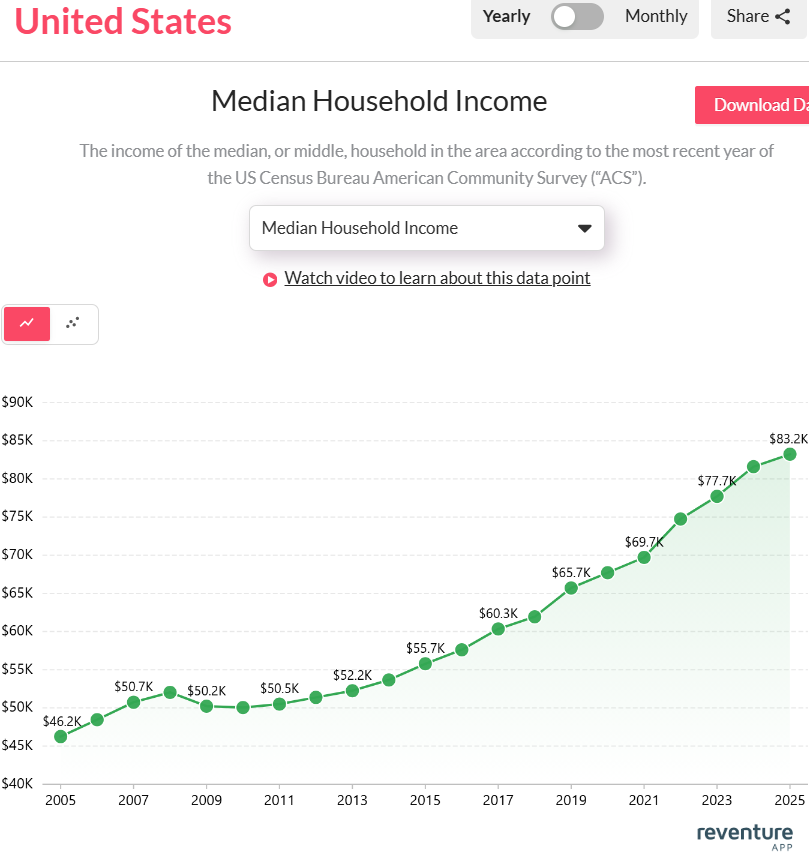
U.S. median household income climbed to $83,200 in 2025. Access the above graph here. [Link]
So, while nominal income is up, real purchasing power has slipped. A household earning $83K today faces mortgage payments 60–70% higher than in 2020 for the same house. That’s why even middle-income families are staying put. They can’t afford to trade up, and renting feels like a setback.
This mismatch between income growth and housing inflation has quietly locked millions out of mobility. It’s not just retirees sitting tight anymore. It’s dual-income couples, millennials with kids, and remote workers who once dreamed of upgrading. They’re anchored by affordability, not choice.
3. The Price Chill
Finally, there’s home value growth or the lack of it. U.S. home value growth has cooled to 0.1% year-over-year in 2025, a dramatic fall from the 17.8% surge in 2021. That’s the steepest cooldown in modern history.
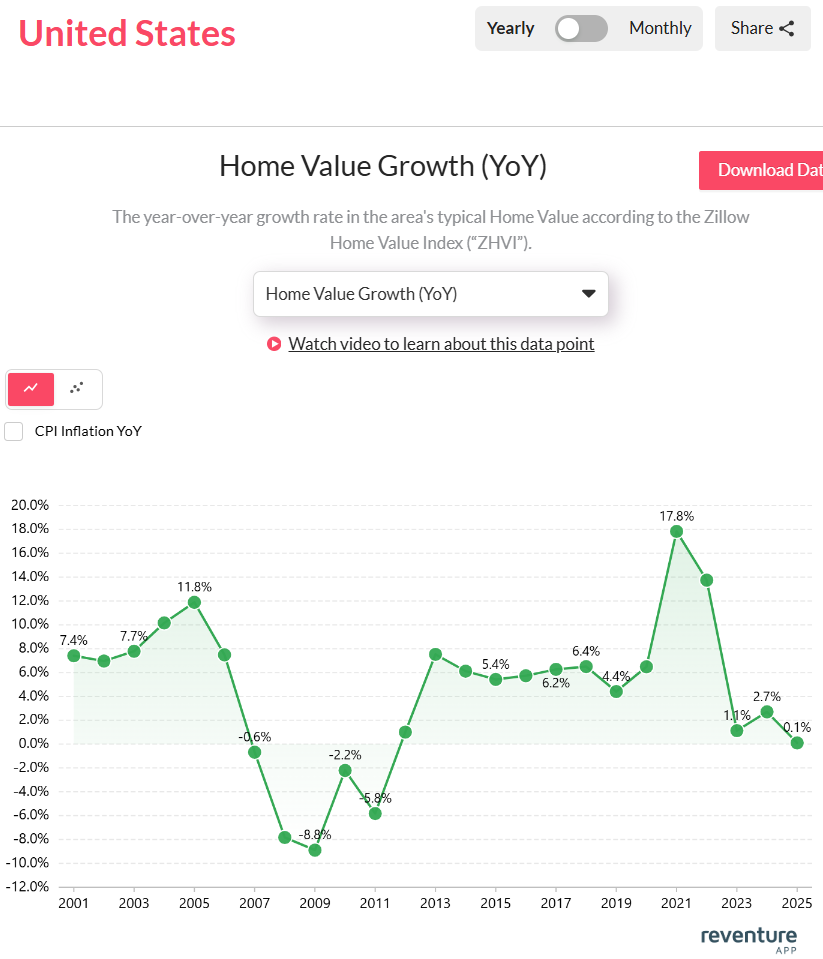
Home price growth has nearly flatlined, rising just 0.1% in 2025, down from the 17.8% boom of 2021. Access the above graph here. [Link]
When prices stop climbing, the incentive to sell fades too. Many homeowners who stayed through the boom now see no upside in listing. They’d lose equity gains to higher rates and stagnant prices. It’s a psychological freeze as much as an economic one.
The ‘Great Stay’ has effectively turned homes into illiquid assets. Equity looks good, but it’s stuck. And it is locked behind low rates and high replacement costs. Even investors are slowing down, with fewer fix-and-flip opportunities and weaker rent-to-value ratios.
Final Words
If this trend continues, housing could enter a new era of stillness. One where movement slows, not because people can’t buy. But because they simply refuse to sell. The result is a market that breathes less, moves more slowly, and holds tighter than ever before.
See how the ‘Great Stay’ is playing out in your city. Find which areas are stuck and which are finally moving again by exploring the data on Reventure Premium. It’s just $49 a month and gives you 6x better forecast than Zillow.
And you will be able to unlock 40+ data points, from income-to-value ratios to inventory growth and rent burdens. Because in a market where homeowners are staying put and supply is still tight, timing and precision aren’t optional. They’re your advantage.
Upgrade to Reventure Premium