
The fastest-appreciating housing markets in America are not where many buyers or investors would expect.
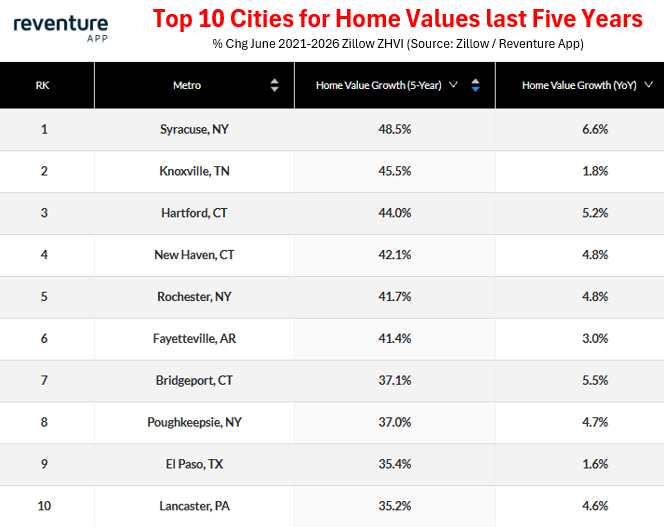
Since 2021, home values in Syracuse, New York, have surged roughly 49%, while Rochester prices have climbed 42%. Hartford, Connecticut, is up 44%, and New Haven has gained 42%. These relatively affordable Northeast metros are now outperforming many of the Sun Belt markets that dominated housing headlines during the pandemic.
The shift points to an important change in the Upstate New York housing market: affordability and scarce inventory are becoming powerful drivers of home price growth.
Markets that experienced relatively little appreciation before the pandemic entered the latest housing cycle from a much cheaper starting point. Now, with buyers increasingly sensitive to affordability and remarkably few homes available for sale, some of these previously overlooked cities have become America’s strongest housing markets.
But after five years of rapid appreciation, Reventure data also shows a new risk emerging: some Upstate New York markets are approaching 30% overvaluation.
That raises a critical question. How much longer can the boom continue?
Upstate New York Housing Market Leads Five-Year Home Price Growth
Looking at America’s strongest housing markets since 2021 produces an unusual leaderboard.
Syracuse leads with approximately 49% home price appreciation, followed closely by Knoxville at 46%. Hartford ranks third at 44%, while New Haven and Rochester have each appreciated around 42%.
Other affordable markets, including Fayetteville and El Paso, have also performed strongly.
The rankings make the geographic shift especially clear. Four of the top eight markets are in New York or Connecticut, with Syracuse taking the No. 1 position nationally. Instead of the pandemic-era Sun Belt boomtowns dominating the list, several comparatively affordable Northeast metros have moved to the front.
What’s notable is what’s missing.
Many of these cities weren’t major pandemic migration destinations. Institutional investors and homebuilders weren’t rushing into Syracuse or Rochester the way they were into markets across Florida, Texas, Arizona and Tennessee.
Yet several of these quieter Northeast markets are now outperforming them.
The reason starts with what houses cost before the pandemic.
Affordable Home Prices Created Room for Growth
Many Northeast housing markets experienced lackluster appreciation following the 2008 housing crash.
That looked like a weakness at the time. Today, it’s part of their advantage.
While housing values soared in many coastal and Sun Belt metros during the 2010s, markets such as Hartford experienced years of stagnation.
That search for affordability is also reshaping where investors can find value, particularly as buyers look beyond expensive boomtowns toward housing markets offering higher cap rates and lower entry prices
Hartford provides one of the clearest examples.
Home values there peaked around $271,000 in 2007. After the housing crash, prices took approximately 14 years to return to that level, finally recovering around 2021.
The long-term chart shows just how unusual Hartford’s recent boom has been. Homeowners experienced more than a decade with virtually no appreciation after the previous housing bubble, leaving prices at a relatively affordable starting point when the pandemic boom arrived.

That meant Hartford entered the pandemic housing boom from a comparatively affordable starting point.
Once demand strengthened, there was significantly more room for values to rise.
Why the Upstate New York Housing Market Was Different
Syracuse followed a different path, but the result was similar.
Unlike many American metros, Syracuse never experienced a dramatic housing bubble before 2008—and therefore never experienced a major crash afterward.
The largest annual decline in Syracuse home values over roughly the last 25 years has been only around 2%, while its strongest annual increase has been approximately 16%.
Syracuse’s longer-term price history illustrates that stability. Instead of experiencing the dramatic boom-and-bust cycle seen in markets such as Phoenix or Las Vegas, values moved gradually higher for much of the 2000s and 2010s before accelerating after 2020.

That historical stability meant housing remained relatively inexpensive compared with many larger Northeast metros.
And when affordability became increasingly important to buyers after mortgage rates surged, cities such as Syracuse and Rochester suddenly became much more attractive.
But affordability isn’t the only reason prices are rising.
There simply aren’t enough homes available.
Housing Inventory Remains 30% to 50% Below Normal
Housing supply remains exceptionally tight across parts of New York and Connecticut.
In many markets, active inventory is still approximately 30% to 50% below pre-pandemic norms.
That creates a very different housing environment from markets in Florida, Texas and Arizona, where inventory has surged above historical levels.
One reason is the mortgage rate lock-in effect.
Millions of homeowners secured mortgages around 3% during the pandemic. Selling means potentially replacing that loan with a much more expensive mortgage, giving existing owners a powerful financial incentive to stay put.
Turnover is also historically low in many Northeast communities.
When fewer owners list their properties, buyers end up competing over a relatively small pool of available houses.
Bridgeport, Connecticut, shows how extreme the shortage has become.
Bridgeport Housing Inventory Has Collapsed 74%
The Bridgeport metro, which includes Stamford, had more than 6,000 active listings in June 2019.
By June 2026, supply had fallen to only around 1,600 listings.
That’s an extraordinary 74% decline in available housing inventory compared with the pre-pandemic market.
The inventory chart below helps explain why home prices can continue rising even in a high-mortgage-rate environment. Bridgeport hasn’t experienced anything close to a normal inventory recovery. Supply remains a fraction of where it stood before the pandemic.

When supply contracts that dramatically, even moderate demand can create intense competition.
Buyers have fewer options. Desirable properties receive multiple offers. Sellers gain leverage.
And home prices continue climbing.
This dynamic helps explain why Northeast markets can appreciate even while broader U.S. housing demand remains historically weak.
However, there is a limit to how far that dynamic can go.
Reventure Expects More Growth Into 2027
Reventure’s housing market forecasts currently anticipate continued appreciation across many of these Northeast markets into 2027.
Several fundamentals remain supportive.
Inventory is extremely constrained. Housing remains relatively affordable compared with expensive nearby metros, and migration patterns are beginning to favor some lower-cost cities again.
That means the Upstate New York housing market could remain one of America’s strongest regions in the near term.
But there’s an important difference between today’s market and the one buyers encountered five years ago.
These cities aren’t nearly as cheap anymore.
Upstate New York Housing Market Is Becoming Overvalued
Rapid appreciation has pushed valuations in some markets into unfamiliar territory.
Reventure’s overvaluation metrics now show Syracuse, Rochester and Buffalo approaching 30% overvaluation relative to underlying local fundamentals.
With markets like Syracuse approaching 30% overvaluation, the trend also connects to the broader U.S. housing bubble and affordability problem that has pushed home values far beyond historical fundamentals in many parts of the country.
Looking across Upstate New York reveals how widespread that shift has become. Markets that historically attracted buyers because of affordability are now showing some of the highest estimated overvaluation levels in the region.

That’s significant.
Five years ago, affordability was arguably one of these markets’ greatest strengths. Continued appreciation is gradually eroding that advantage and making it harder for local incomes to support prevailing home prices.
Syracuse is particularly interesting.
For much of the last 25 years, the metro was fundamentally undervalued according to Reventure’s measurements. Now, after its extraordinary post-pandemic run, the market is approaching 30% overvaluation.
The speed of that reversal is striking. Syracuse spent much of the previous two decades at or below its estimated fundamental value before moving sharply into overvalued territory after the pandemic.

There isn’t much historical precedent for how markets like Syracuse will behave at these valuation levels.
And that’s where the risk starts to increase.
Could the Northeast Housing Boom Eventually Slow?
High overvaluation doesn’t automatically mean prices are about to crash.
Housing markets can remain overvalued for extended periods, particularly when inventory is extremely constrained.
And that’s currently the key factor supporting Syracuse, Rochester and other Northeast metros.
But the higher prices climb relative to incomes, rents and underlying fundamentals, the more vulnerable a market can become if inventory eventually recovers or demand weakens.
For now, the fundamental story remains favorable.
Supply is scarce. Prices remain affordable relative to many neighboring Northeast markets. And buyers searching for value are increasingly looking toward cities they might have ignored several years ago.
That’s why Reventure expects many of these markets to continue appreciating into 2027.
But buyers shouldn’t assume that strong historical appreciation guarantees strong future returns.
And that’s where buyers need to shift from looking at national or even metro-level headlines to analyzing the individual ZIP code. A market can still be appreciating while certain neighborhoods have already become significantly overvalued, making the purchase price increasingly important.

Before purchasing, check Reventure’s 1-Year Price Forecast and Overvaluation Rate for your ZIP code. Together, these metrics can help identify where prices are expected to move next—and whether today’s asking prices put you at risk of overpaying.
The Upstate New York housing market may still be booming.
The bigger question is how long affordability can remain its advantage if home prices keep rising this quickly.